Saturday, June 21, 2014

Identifying North Carolina's Venomous Snakes Part 3: Rattlesnakes

Hi everyone!

Here is the next part of the series I have been doing on North Carolina's Venomous Snakes. Before getting into the next species' I would like to say that venomous snakes play a very important part of the ecosystem and are quite beneficial to people despite the bites that do occur. These snakes  help keep populations of rodents and other animals in check, and are food sources themselves to other animals. In the book Snakes of the Southeast Mike Dorcas and Whit Gibbons says it best when talking about venomous snakes. "Venomous snakes have fangs and venom for capturing prey, not to bite people. Because no venomous snake preys on humans, the only reason they bite humans is in self-defense, and then only as a last resort." Also, there many cases that snake venom is being used in the medical field to treat a lot of different things  and gain new insight on how the human body works. I would highly recommend you research it and learn more about it, it is cool!

Now, to talk about Rattlesnakes! Below I put a video ( I did not film it) from You Tube of a Timber Rattlesnake rattling its tail so you can hear what that is like. I think it is pretty cool! *I would not advise approaching a rattlesnake and  making attempts to get it to rattle its tail*


In total, there are 3 different species of Rattlesnakes in North Carolina; 2 of which can come in different color variations. *As far as identifying them; the rattle on the tail is the big clue to look for*. 

We will begin with the Timber Rattlesnake.

 
Black-Phased Timber Rattlesnake. Photo by Ray Hopkins


Yellow-Phased Timber Rattlesnake. Photo by Ray Hopkins


Canebrake Phase. Photo by ME.


The Timber Rattlesnake is one of the 2 Rattlesnakes in NC that is varied in color. In the mountains of North Carolina they will either be the black phase or yellow phase like the ones pictured. Once you get into the Timber Rattlesnake's range in the Piedmont and Coastal Plain, they will be what is called the Canebrake phase that is pictured above. In fact, these guys are most often called Canebrake Rattlesnakes by scientists, due to they like to hangout in Canebrake thickets.

Historically, Timbers were found all over the state, but that has long since changed due to habitat loss

Timber/ Canebrake Rattlesnake Range in NC. Photo from herpsofnc.org

They eat primarily rodents but would likely take a bird or some other critter if the opportunity presented itself. They, like all rattlesnakes as well as the copperhead and cottonmouth I have written about, will rely on their pits to sense the heat from the rodent's body. Timbers generally ambush prey and will inject it with venom.

Despite the fear surrounding rattlesnakes, the timber rattlesnake is actually a rather docile snake. According to Amphibians and Reptiles of The Carolinas and Virginia authors Jeffrey C. Bean, Alvin L. Braswell, et al. write: "When discovered, these rattlers usually remain still or attempt to escape. They will, however, vigorously defend themselves when provoked." Basically, if you leave the snake alone, it will leave you alone. They rely heavily on camouflage to hide from predators and prey a like.  A bite from these guys can be very serious, so it is recommended to get medical attention.

A fun little fact I will share with you about these guys is that they, like all pit vipers, give live-birth rather than lay eggs.


Ok, so the next snake is the Carolina Pygmy Rattlesnake

As you could probably tell from the pictures, Pygmy Rattlesnakes are small. The authors of Amphibians and Reptiles of The Carolinas and Virginia write that 26 inches is the longest they can get, generally. Being as small as they are, they are considered to be the "least" venomous snake of NC's  6 species that are venomous. However, a bite can still cause a great deal of discomfort and it is highly recommended that a bite should get medical attention. That being said, like other snakes, they will only resort to biting if they have no way of escaping.  
Photo Taken From Internet.


Pygmies are rather brilliantly colored animals that vary from the gray coloration to the brick red color. In North Carolina, they primarily dwell in the coastal plain and sandhills but do also occur in one location or so in the mountains. They like to hang around bodies of water in pine forests, sandhills, and mixed hardwood forests among other places. Snakes of The Southeast. 

Photo from Internet.


By the looks of things, you are probably wondering what would these little guys eat? Well, they eat small critters such as: lizards, small rodents, small amphibians, and other small critters.

The fun fact I will share with you is that they do have a rattle, but it is tiny and can be difficult to hear.
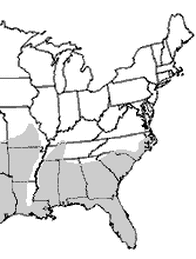
Image result for Pygmy Rattlesnake range in NC
Pygmy Rattlesnake Range. Photo from Internet


Our final Rattlesnake that we will be learning about, is sadly not doing well, and is on the verge of extinction in the state of NC. It is a truly unappreciated, amazing snake with lots of fear around it. I hope this blog will help you learn how cool, not only this species is, but all of NC's rattlesnakes.

The Eastern Diamondback Rattlesnake has been brought to the verge of extinction in NC due to habitat loss and being killed.  They can be quite large snakes, getting up to 78 inches. Amphibians and Reptiles of The Carolinas and Virginia.

Photo Taken From Internet


Photo by Me


The Eastern Diamondback Rattlesnake can be quite large as I have written before. An adult can take on and eat something as large as a rabbit! Like the other rattlesnakes, they have pits. They will ambush their prey and inject it with venom. Diamondbacks will eat other rodents too when they get the opportunity.


They spend a good deal of their time hanging out near and in stump holes and similar hiding places in forests, fields with lots of brush, and similar habitats.

In NC, they are found in the coastal plain. 

Eastern Diamondback Rattlesnake Range in NC. Photo from herpsofnc.org

Diamondbacks are rare in NC, so it is not likely to be encountered while your out in the woods on a hike. When they are encountered, they could "quickly assume a defensive posture: body coiled, rattle erect and buzzing, neck flexed with head directly facing the source of annoyance." Amphibians and Reptiles of The Carolinas and Virginia. These guys are thought to be one of the most dangerous snakes in the Southeast, so caution should be shown when encountered like any other animal. Bites from these snakes are very serious and medical attention should be sought.

Fun fact for these awesome animals is that they have been seen swimming in salt water.

Well, I hope you have learned something about Rattlesnakes. They are very cool creatures that want to be left alone to do their own thing. I am really fascinated by their rattles and the sound they make. By the way they find, capture, and eat their prey. As well, as how well they can blend in to their environment. I think the fact they are sort of chunky, heavy animals is pretty neat too. They are something that you do not need to fear. If you respect them like you would a car or a knife in the kitchen when you are preparing a meal or even eating a meal, you will be fine. Once again, feel free to ask me any questions you may have.


A big thanks to my friend Ray Hopkins for the use of the Timber Rattlesnake photos. Rachel is passionate herper and of course, an excellent photographer.


Timber Rattlesnake. Photo by Ray Hopkins. 


Sunday, May 25, 2014

Identifying North Carolina's Venomous Snakes Part 2: Copperheads


Hello Friends!

In this blog I will continue my series on North Carolina's venomous snakes to help you better understand them and hopefully, identify them on your own. Most of the photos in this blog were taken by a few friends and I would like to say thank you to them for the use of their photos.

Let us begin, shall we?

I first would like to test your knowledge. See if you can identify the Copperhead (no scrolling down and peeking)

Photo from Internet

Photo by ME. 


Photo taken off Internet


So, Copperheads, like Cottonmouths are in the Pit Viper family. What distinguishes them is that they have fangs in the front of their mouth that are move able. These fangs according to Snakes of The Southeast by Whit Gibbons and Mike Dorcas "Fold up against the roof of the mouth when not in use."  Another trait, is that  between their eyes and nostrils, they have another pair of holes called pits. Gibbons and Dorcas. These pits are used like heat sensors; they detect the heat from the body of mammals which makes up a part of their diet.

Though this snake is Not a Copperhead, it is a Pit Viper. The hole between the nose and eye is the pit. Photo by Katherine J. Photography.
Copperhead. Photo by Adrian Yirka


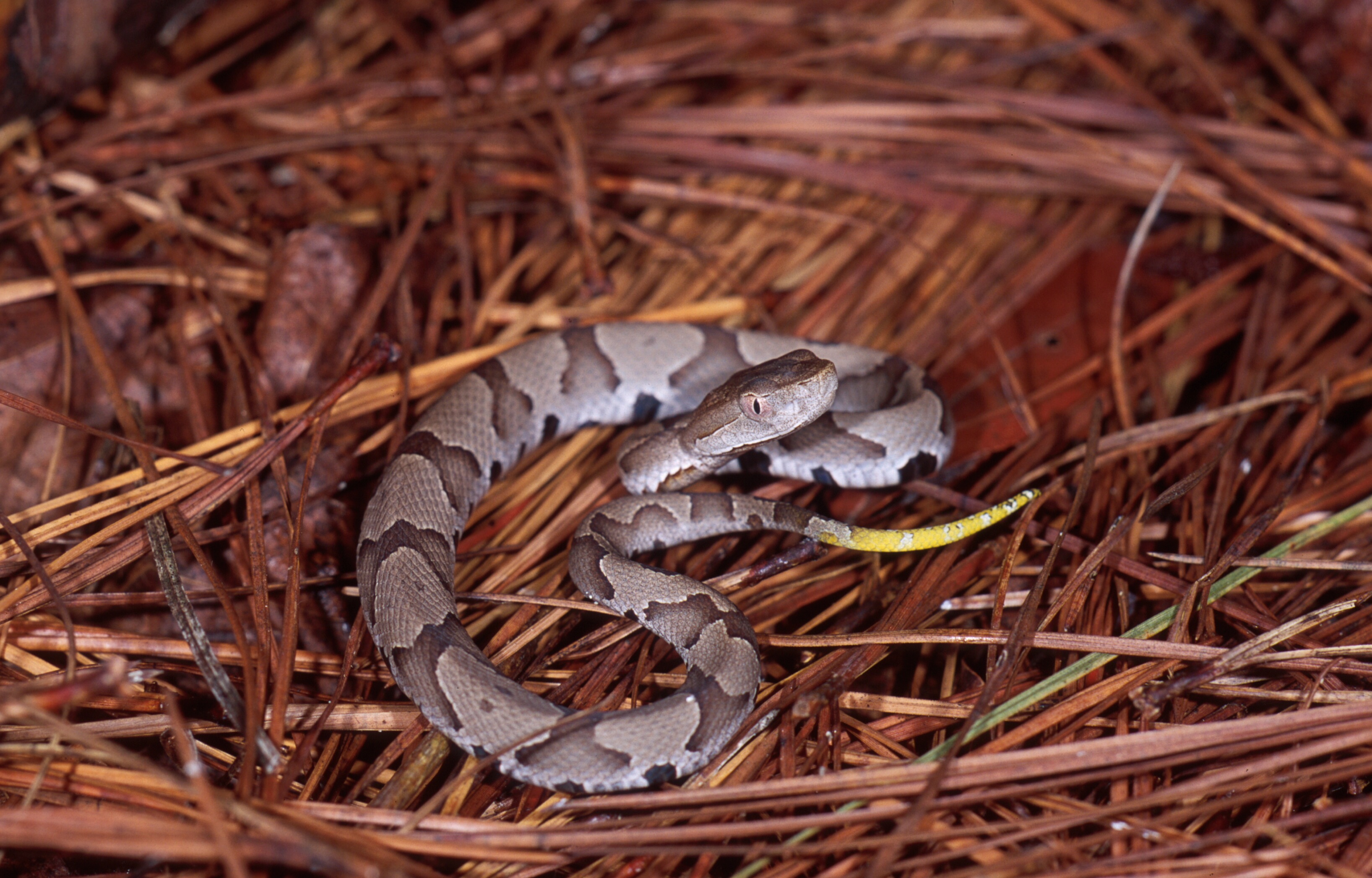
That being said, Copperheads do eat mammals as well as other reptiles, amphibians, and birds when opportunities present themselves.They primarily ambush their prey, but sometimes will forage for food. The babies ( called neonates) have a lime-green to a yellow-colored tail ( pictured below) they will wiggle it and lure in prey ( mostly lizards and frogs).

Copperhead eating a Cicada. Photo by ME.


In the Piedmont region, The copperhead is the most common venomous snake. Cottonmouths have been found in Wake County, but are considered rare. Timber Rattlesnakes are found in a few places, but are uncommon to rare. They have historically been found in Durham, but I can not say for sure if they are still there.


Copperhead. Photo by ME.


Image result for baby copperhead
Neonate copperhead. Note the yellow-green tail. Photo from herpsofnc.org


Range of Copperhead in NC. Photo from herpsofnc.org


As their name suggests, they are a coppery color and can be found in various habitats that provide plenty of hiding places, food sources, and water. Copperheads are most active at night, but can sometimes be encountered basking during the day. They can be quite difficult to see as they blend in perfectly with the leaves and other debris common to the areas they like to hang out at. They rely on this camouflage to remain hidden from prey they ambush and from predators that would eat them.

Copperhead. Photo by Adrian Yirka
                                                                                                                                                 

In regards to Copperheads and their venom, they generally blend in so well with their surroundings, they are not seen until they are stepped on. They rely a lot on not being seen to avoid becoming a meal. Despite the fear and misunderstanding of them, they are not out to get people and are not super aggressive. That being said, they still will bite if they feel threatened, provoked, and are stepped on. Often bites occur when people are out in their yard at dusk and are not watching where they are putting their hands and/or feet.

Copperhead bites are " although rarely if ever fatal to humans, are serious and should receive prompt medical attention." Amphibians and Reptiles of the Carolinas and Virgina
by Jeffrey C. Bean, Alvin L. Braswell, et al. 

Therefore, it would be a good idea to know how to identify a copperhead, especially if you live in wooded areas. Here are some good clues you can use without having to get too close:

1. Copperheads are a coppery color.
2. Look on the pattern; they have a band pattern shape that I have heard some people describe as Hershey kisses, horse saddle, and even described as an hour glass.
P


Note the "Hershey's Kiss" pattern. Photo by Adrian Yirka


Now that you the reader have an basic understanding on how to identify a Copperhead, I will now briefly share a few non-venomous snakes that they are often confused with.


Mole Kingsnake. Photo from Internet

Mole Kingsnake: These guys are not well heard about snakes and this could very well be your first time hearing of them. They like similar habitats to copperheads; in particular, open fields and forested areas. These snakes will eat other snakes in addition to small mammals and other small critters. The pattern is a good way of distinguishing this snake from a copperhead.This snake lacks the "Hershey Kiss" band pattern. There is a difference in the coloration of the snake too.


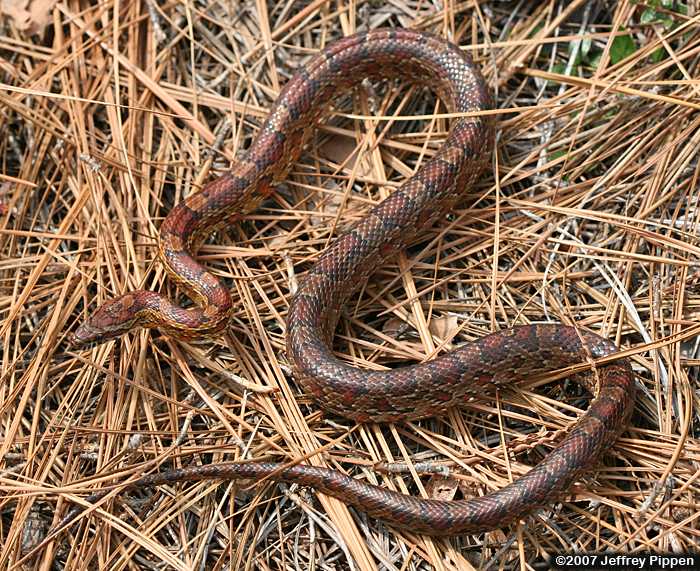
Corn Snake: These snakes are one of the most commonly kept as pets and are well known. Sadly, these guys are often killed for appearing to be a copperhead. They like similar habitats to copperheads, though they are more happy in sandhill-like places.  Again, look at the pattern to differentiate them from copperheads. Coloration can be a factor as well, as corn snakes can be all sorts of colors.


As I conclude this blog on Copperheads, I surely hope you have learn something as is my hope for all my blogs that people read. I hope you have learned to identify a copperhead and a few non-venomous snakes that is often mistaken for it.  If you have an questions, feel free to ask me, I would be happy to help in any way I can.

Also, a big thank you to Adrian Yirka for allowing me to use a few of his photos. He his passionate about herpetology and many things of the outdoors, He has be involved at the NC Museum of Natural Sciences for many years.


Photo by ME. 

Tuesday, April 22, 2014

Identifying NC Venomous Snakes Part1: Cottonmouths (Water Moccasins)

Hello friends,

Now that NC is well into the warm weather (for now at least) you are most likely to have seen at least one snake out and about. I thought I would do a 4 part blog giving you some general clues to identifying NC's venomous snakes. This first part will be about The Eastern Cottonmouth (A.K.A "Water Moccasin").


So, Eastern Cottonmouths are found around swamps, ponds, tributaries, floodplains, and streams. They generally do not hang around fast moving rivers. Snakes of the Southeast by Whit Gibbons and Mike Dorcas.  They eat a wide range of critters; small mammals, fish, and other reptiles among other things. In fact, I recently saw a Cottonmouth with another snake in its mouth! Cottonmouths are pit vipers that kill prey with venom.


A good way to identify Cottonmouths is that they are rather impressive, sort of chunky looking snakes.
This chunky look is a good clue to look for. 


Another way to identify a cottonmouth is the distinctive broad, dark brown stripe along the side of its face. Note* Not all cottonmouths will have a full stripe along the side of face, but it could still be a helpful clue.* It is quite prevalent in the individual pictures above. If you look at the picture and along with seeing the stripe, you may notice the pattern and coloration of this snake. Cottonmouths actually have quite distinctive patterns that stand out from water snakes. According to Amphibians and Reptiles of the Carolinas and Virginia by Jeffrey C. Bean, Alvin L. Braswell, et al.  Their "Dorsal ground color is usually olive or brown, and dark crossbands with light centers constitute the body pattern."  The neonates (babies) are much lighter color with a more eye catching pattern, along with a yellow to yellow-green tail. 

Another thing is the range of the snake: There are records of Cottonmouths in Wake County, but they are rare. 
Cottonmouth Range (
 map comes from herpsofnc.org)


As you read this, you may be wondering about the eyes. Well, Cottonmouths have cat-like eyes; the term is called elliptical. Water Snakes have round pupils. However, you have to get rather close to the snake to identify the eye, which I would not recommend doing if you have not been trained or your uncomfortable with doing so. Therefore, I am trying to give clues you can use without having to get too close :) 

In addition to the appearance, a way the snake behaves can actually help identify it. The reason a "Water Moccasin" is called Cottonmouth is because if threatened and has no way to escape, it will gape its mouth such as the one pictured above is doing in order to startle the predator and make think twice about eating it. The inside of the mouth is white; hence cottonmouth. So if a water snake does that, then it is probably a cottonmouth, though you may not want to harass the snake to find out ;)  I will say Cottonmouths have a bad rep and really, they are not as aggressive as people think they are. They want to avoid people as much as many people want to avoid them,


A final note I will make about identifying Cottonmouths is like all pit vipers, they have a pit on each side of their face. According to Snakes of the Southeast by Whit Gibbons and Mike Dorcas It is "A heat-sensitive pit between the eye and nostril." The pit "can detect heat." Gibbons and Dorcas. They use it to hunt prey. But you would have to get pretty close to the snake to see it. 

As far as the water snakes go, I am just posting very brief info and pictures about them. The pictures should give you an idea of how different cottonmouths and water snakes really look. 

Northern Water Snake 

Northern Water Snake Range in NC. Photo from herpsofnc.org

Northern Water Snakes (pictured above) are fairly common in our area. They "typically have alternating bands of reddish brown and lighter brown on the front part of the body, changing to alternating square blotches on the back and sides toward the rear of the body." Snakes of the Southeast. So you are mostly likely to see these guys. I will *note: Water snakes heads are more slender, cigar shaped. Cottonmouths heads are more triangular.*


Red-Bellied Water Snake


Range of Red-bellied Water Snake ( Note* orangish-red coloring on belly is key clue for identification) (maps come from herpsofnc.org) (pulled from google)


Brown Water Snake
Range in NC. So, you will not see these guys in Wake County.  Note* Have black square patterns on body, good clue to identifying them*


Banded Water Snake. Note* Have "black, brown, or reddish crossbands...a dark stripe from the eye to the angle of the jaw."* Good clue to identify. source: Amphibians and Reptiles of the Carolinas and Virgina.
Banded Water Snake


So, I know this blog a quite lengthy, but I hope you learn something about Cottonmouths and have an understanding of telling them apart from water snakes. At some point I will do a post on water snakes.  Again, feel free to ask me any questions you may have :)


Tuesday, March 25, 2014

Jello in Nature

About this time of the year if you were to take a walk around wetland areas that have some depressions in the ground; filled with water, it is very possible you may see some jello-like clumps that are clear to a cloudy -white color ( though they can sometimes be a brownish color too) with black spots all over them. These jello looking clumps are salamander eggs.

Spotted Salamander Egg Mass
These eggs in particular are Spotted Salamander eggs.  You  may remember me writing a blog about Marbled Salamanders a while back. Well, the spotted salamander and marbled salamanders are in the same family; the Mole Salamander family (they get that name because they spend alot of time underground). The genus name is Ambystomatidae for anyone wanting to know the fancy, science term.   


The Spotted Salamander will have either a lot of orange and/or yellow spots or very little spotting. It dines on insects and other small critters. Typically it spends much of the year underground, but after a warm rainstorm during the late winter to early spring, will come above ground and migrate to nearby temporal pools.

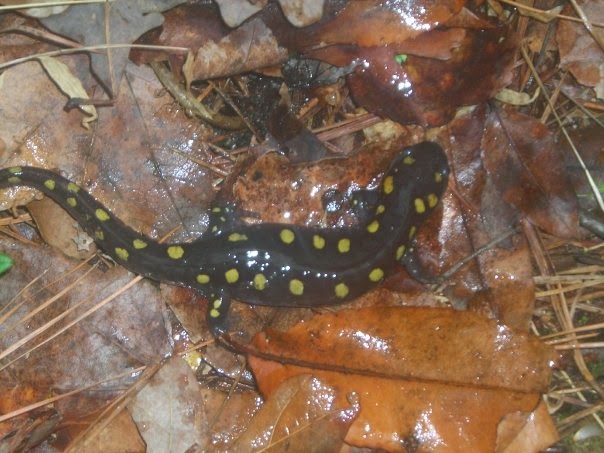
Spotted  Salamander


In the pools, according to Amphibians and Reptiles of the Carolinas and Virginia by Jeffrey C. Beane, Alvin L. Braswell, Joseph C. Mitchell, et al. "Up to 350 eggs are laid in clear to opaque, jellylike masses attached to sticks and stems in the water." The salamanders will soon after return underground.

Temporary Pool


Spotted Salamander Eggs from temporary pool pictured above


Spotted Salamander  Egg Mass attached to a stick


Eventually the eggs hatch into larvae and then later, the larvae transforms into a salamander. Pictured below is a morphed Spotted Salamander.

Photo by ME.


In this blog I am focusing on the eggs, but I would encourage you the reader to do some research on your own and learn more
about the larvae and about the spotted salamander in general as it is a very interesting species!

Photos are by ME.