Thursday, March 19, 2015

How Snakes Find, Capture, And Swallow Their Prey

Hello Friends,

Spring is upon us and wildlife is beginning or already has begun to be come active. One group of animals in particular that are enjoying the warm weather are snakes! Snakes are reptiles that are commonly misunderstood and feared. Learning more about them can help get people pass the fear and even gain an appreciation for them. We are about to learn some really cool things about snakes that are just few of the many reasons why I love them!

For starters, snakes are animals that are completely lacking in arms and legs, and yet they manage to survive quite well with out them. Have you ever wondered how snakes even find, capture and swallow their prey? Well, you are about to find out...

E. Cottonmouth attempting to eat a ribbon snake. Photo by ME. 


So, What Do Snakes Eat?

Well, snakes are carnivorous, which means they prey on other animals. A neat thing about snakes is that some species of snakes' diets are different from others. In fact, some snakes are what scientists call Specialists, which according to Michael Dorcas and Whit Gibbon's book, Snakes of The Southeast, are snakes that "focus on one or a few prey types." In other words, they dine on specific prey items.

One such example is the Eastern Hognose, which primarily eats toads. The neat thing about them is that they use the pointed end of their nose (hence the name) to occasionally dig up such prey items.

Eastern Hognose Snake. Photo by ME


Another example of a specialist is the Rough Green Snake. This species primarily eats insects and spiders, though they will take a treefrog from time-to-time. (Dorcas and Gibbons)
So not all snakes eat rodents.

Pictured below is a Rough Green Snake. Photos by ME.


In addition to snakes that specialize in a specific prey item to eat, there are also snakes that are called Generalists. Such snakes "eat a wide variety of animals..." (Dorcas and Gibbons).

One example of a generalist is the Eastern Kingsnake. These snakes are commonly known for eating other snakes; even venomous ones. Though they will occasionally do that, they mostly eat small rodents, small turtles, and eggs, among other critters.

Kingnsnake eating another snake. Photo from internet, taken by Pierson Hill.


Another example of a generalist is the Northern Water Snake. Now these snakes will go after small rodents on the occasion as well as insects, but these snakes also "eat a greater variety of fish and amphibians than any other North American snake." (Dorcas and Gibbons). In addition to being active foragers, northern watersnakes will wedge themselves among rocks and move back and forth with the mouth open ready to catch unsuspecting fish, and they sometimes corral fish in shallow water with a body coil. All prey items are swallowed alive." (Dorcas and Gibbons)

How cool is that?

N. Water Snake eating fish. Photo from Internet


Now that we have an idea of what snakes eat, the next question we will take a look at is, How Do Snakes Find Food?

Well, snakes primarily find their food through use of sight, scent, and for some species, heat sensing pits. In regards to hearing, snakes have very poor, to little hearing so that is not a factor in finding prey. As far as I know.
Some snakes, such as Black Racers are known for having excellent vision and use this to their advantage to find food. (Dorcas and Gibbons)

Black Racer. Photo by ME.

In regards to scent, this is a very important sense that snakes rely on to find food. You may be wondering how a snake exactly is able smell? What a snake does is flick its tongue, which gathers odor elements from the environment and is sent up into the root of the mouth to be identified by what is called the Jacobson's Organ.

A rough sketch by me showing you where the Jacobson's Organ is located on a snake. 


Below is an Eastern Garter Snake flickering its tongue to pick up odor elements from its environment.

Eastern Garter Snake. Photo by ME.


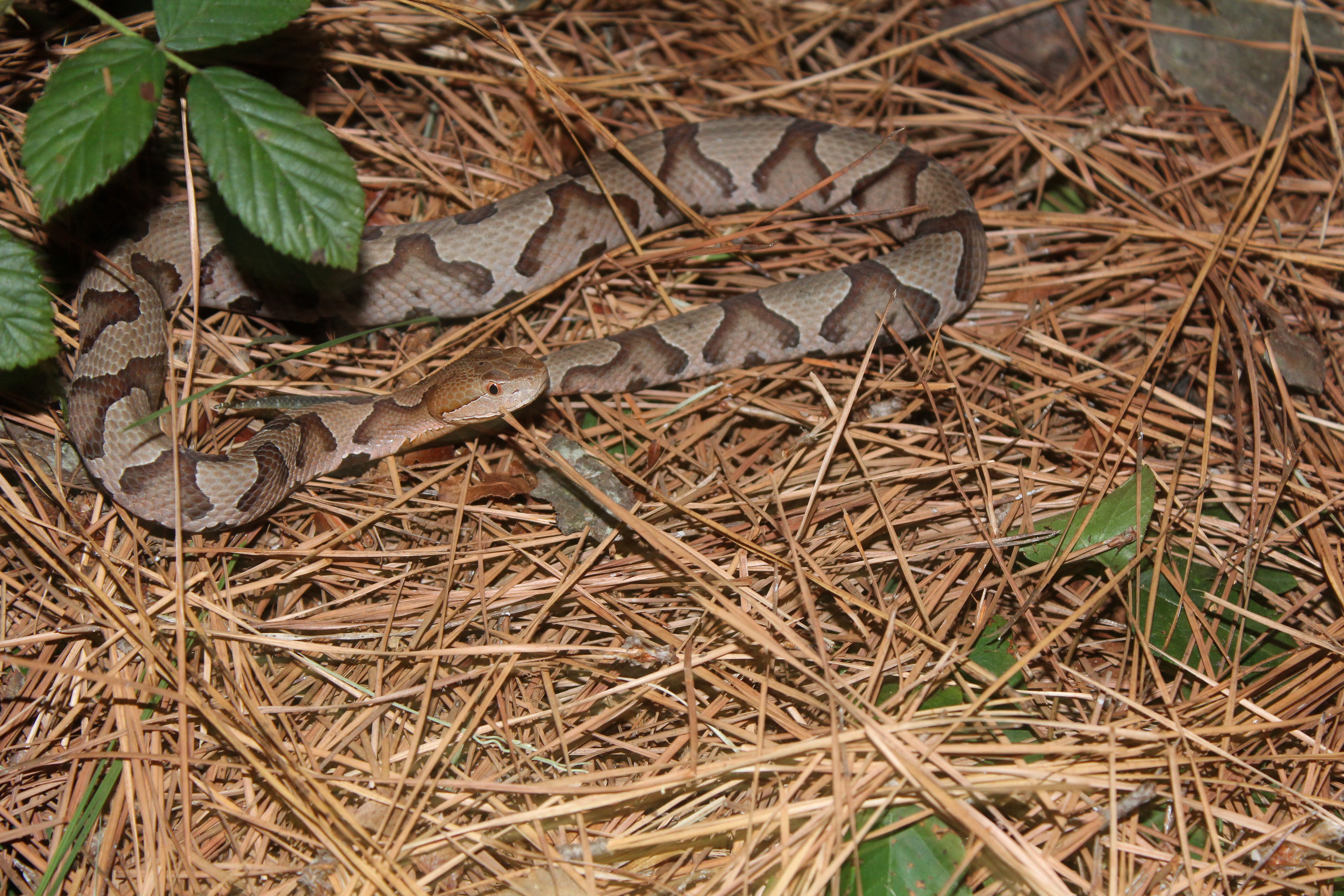
So, sight and scent are important in helping a snake find its prey. There are some snakes that in addition to sight and scent, also have heat sensing pits. Some( I say "some" because Emerald Tree Boas among some other snakes have labial pits and are not considered pit vipers.) of these snakes are called Pit Vipers; which includes Copperheads, Cottonmouths, and Rattlesnakes.

These pits are located on both sides of the pit viper's head; in between the eyes and nostrils.

According to David Badger's book, Snakes, "Each pit have 2 chambers; separated by a thin membrane equipped with nerve endings. The nerves in this membrane are extraordinarily sensitive to the slightest change in temperature." The snakes that have pits, uses them to detect the body heat from any potential mammalian prey.  It's awesome!

Pictured below is a Tropical Rattlesnake and if you look closely, you can see one of its pits. It is the "hole" between the eye and nostril.


A rough sketch by me showing where the heat-sensing pit is located on a pit viper.


Can you find the pit on the snake below?
Photo by ME


As you can see, snakes have the means to find food, now the question is, How Do Snakes Capture Prey?

Snakes are just about as diverse in their methods of capturing prey as their diets. Often times, people think of boa constrictors constricting a capybara or some kind of large prey item.  Constriction is one way many snakes captures, kills, and swallows their prey for sure. The snake will strike at prey item, wrap its body around it and then constricts until the prey is dead.
Kingsnakes constrict their prey; even other snakes! Rat Snakes are also constrictors and will constrict a variety of prey items, which makes them generalists. What's neat about them ( and Corn Snakes too) is that they are good climbers and will climb up into trees for bird eggs and even birds if they get the chance to capture one.
Black Rat Snake climbing. Photo by ME.


Another method, once the prey item is found, is to strike, hold and then swallow, in some instances, swallowing the prey alive. Black racers are an example of this, as they track down their prey and strike it, followed by swallowing it.

Along with this method, many snakes employ the technique of ambush. We have already learned about how northern water snakes will sometimes ambush and even corral fish. Rough greens will ambush and then grab, hold, and swallow prey.

A really cool method of ambushing prey some snakes use, is by luring them in. Such examples of this is by neonate (baby) Copperheads and Cottonmouths. These neonates "wiggle a brightly colored tail tip to attract potential prey, such as frogs or lizards, within striking range." (Dorcas and Gibbons)
They do inject venom into their prey, which kills it and then the snakes tracks their prey down. I will write more about venom in a bit. Anyway, these tails are a greenish to yellow color and will fade and get darker as they get older.


Neonate Copperhead. Note the yellow tail. Photo from Internet.


Ok, now onto to venom. As I talked a little bit about pit vipers and the pits early on, these snakes use the pits to pick up the body heat from mammals to find them. Sometimes, they will simply pick up the mammal's body heat and find a place where the prey frequents and will lie in wait to ambush prey. As for venomous snakes that do not have pits, they will usually forage for food or wait until something comes by. Coral snakes grab their prey and chew on it, and releases venom until the venom takes a hold. (Dorcas and Gibbons)

Eastern Copperhead eating a Cicada. Photo by ME. 


There are some snakes that are what scientists call rear-fanged, which means they have fangs in the back of their mouth. As far as I know, only 2 species of rear-fanged snakes are known to be dangerous to people, but a bite from other species can cause unpleasant symptoms too. An example of a rear-fanged snake is the Eastern Hognose Snake we learned about earlier in the blog. Toads, their main prey item, in defense, will puff themselves up in order to look bigger and tougher. Hognose snakes will grab on the toad and "deflate" the toad using the fangs, and perhaps release a mild venom to subdue the toad. Hognose snakes are considered harmless as they rarely, if ever, bite and their fangs are in the back of their mouth.


As you can see snakes have different methods in finding and capturing their food. It is so cool how animals without limbs can be so diverse in surviving! Now we will learn about something even neater about them; How Do Snakes Swallow Their Food?

It is even more amazing how animals lacking limbs can still manage to eat. According to Harry W. Green's book, Snakes: The Evolution of Mystery in Nature, in regards to eating:"Most snakes engulf prey with alternating, side-to-side head movements, made possibly by mandibular liberation, free-swinging quadrates and highly mobile upper jaws." In other words, snakes have expandable jaws that allow them to adjust accordingly so they can grab and swallow large prey items. During the swallowing process, they grab a hold of the prey item with their teeth and then they "walk" their heads over and around it and then they begin to swallow.

Emerald Tree Boa Swallowing a prey item. Note: The Labial Pits around the face. Photo by ME.


Then, "once the prey has entered the throat, peristaltic contractions of the esophagus and sinuous curves in the trunk push it backward to the snake's stomach." (Greene)
Greene also goes on to say that "Snakes lack shoulder girdles and a sternum, the ends of their ribs are separated ventrally, and large food items can pass unobstructed."
On top of that, once the prey item is swallowed, their are some enzymes in the stomach that immediately start breaking the prey item down.

Pretty cool stuff! Of course, during the swallowing process, you may wonder, can the snake still breathe? If so, how?

Let's find out...

Well, first off, snakes, unlike many other terrestrial animals, their windpipe, called the trachea, opens up anteriorly; rather than far back in the throat. (Greene)  Also, snakes have a snorkel-type thing near their tongues called a glottis. Chris Mattison, author of the book The Encyclopedia of Snakes, writes about how it ( the glottis) is " pushed forward and held open during swallowing in order to maintain a passage for air." So, it is sort of like a snorkel that they breathe through, while their prey is being swallowed.  Pictured below is the anatomy of a snake. You can see where the trachea and glottis are located.

Image result for snake glottis
Photo from Internet


If you look closely at the picture below, you can see this Cottonmouth's glottis (the snorkel- looking thing; look for the tiny hole in the snake's mouth)
Eastern Cottonmouth. Photo by ME.


Another cool thing about how snakes are able to breathe, while swallowing prey is that their right lung ( which, interestingly enough, is longer than the left one) stores a lot of oxygen that decreases significantly during the swallowing process. (Greene)

Also due to the fact that snakes are not nearly as active as other animals and that they have low metabolisms, they can go a few minutes in between taking some breathes.
Cool huh?

Another thing to know is that once a snake has swallowed the prey item, the snake will readjust its jaw. If you ever seen a snake "yawn", it is actually readjusting its jaw after having a meal.


Below is a video of my corn snake eating. As you watch, you can see it as it works its head over the rodent, its jaws are expandable and moving around. You can also see, though the video quality is not great, the glottis is " pushed forward and held open." (Mattison) At the end of the video, you can see the snake readjust its jaw.


Well, I hope you have learned a lot in this blog; I know I have learned a lot over the year that I have worked on this project. I hope you see this project on a professional poster someday, as an educational tool. As always, feel free to ask me questions you have or even any observations you may have made regarding snakes eating.


I would like to thank the North Carolina Museum of Natural Sciences, in particular the Terrestrial Exhibits and Library Department for the opportunity to work on this project and the use of the great books and other resources that was super helpful in bringing this work together. A big thanks to Phil Bradley, Jeff Mette, Henry Wood, Nick Allen, Sarah McGrath, My family, and everyone else who helped me and encouraged me throughout the time I worked on this project.





Tuesday, February 17, 2015

Nature Journaling

Hello Friends,

It is once again that time for another blog. This month, I thought I would do something a little different. In this blog were are going to learn about Nature Journaling.

Photo by ME


Here we go:

Nature journaling is a great way to get out and up close to the outdoors as well as, get away from so much television and other electronics ( which are great in moderation, but people just do not out like they use to, particular, kids.). It is great way to relax and escape stress for a bit. It is also a great way to learn about and study nature, in fact:

"The overwhelming majority of people who become good naturalists don’t gain their knowledge from formal schooling. They get it in the field, by devoting themselves to direct observation and spending time with other largely self-taught naturalists. Nature journaling is a process that fosters self-learning, challenging the observer to combine intellect with experience” (Keeping a Nature Journal: Discover a Whole New Way of Seeing the World Around You. Clare Walker Leslie and Charles E. Roth. Foreword by Edward O. Wilson)

So, you see many of the experts got their start from simply just exploring the outdoors and journaling. I have learned a lot as well about nature from journaling. For one thing, taking notes of nature finds and trips has helped me to have a better understanding of when to go look for certain animals I want to find, It helps me to know where to go and what kind of habitat I need to look for, Or, where I previously went if I have found the animal(s) before. So, keeping a nature journal is helpful in that regards. I also write scientific names next to the common name I write down in my journal, this has helped me memorize scientific names.

Getting Started:

To begin nature journaling, you of course, will want to get a journal of some kind. There are so many possibilities of what you could do and use. You can simply use a note book or a sketch book or even a fancy journal from the internet. The neat thing about a nature journal is that you can be as creative with it as you want, it is YOUR journal. Pictured below is a few examples of my nature journals ( the one pictured at the top is mine as well) so you can go with whatever you like. You can get journals anywhere really. Walmart, Target, Barnes and Nobles, etc. The internet is a good place to look as well.
Photo by ME


Photo by ME


You will also need writing utensils of some kind. As far as writing in the journal, I go with a pen of some kind. When I started out nature journaling, I primarily used a pencil, but decided to switch to a pen as I liked it better and it looks nicer.

So those are essential items, but other item you may want to get are: colored pencils, water colors, stamps, crayons, etc. Again, it is your journal, you can be as creative and wild with it as you want to be!  Photos below from Internet. 

Image result for Color pencil set


Image result for watercolors set


You may want to also get a small backpack or some kind to keep your journaling supplies in for storage and carrying purposes.


What To Put In Your Journal:

Again, you can put whatever you would like in your journal. With a nature journal, you generally put nature related things in it. For me, whenever I come across a cool animal or  a nature related thing, I write about it. I write what I saw, where I saw it, when I saw it, and anything else that sticks out to me. Sometimes, I will put down what the weather was like when I saw the animal or plant or whatever that sticks out to me. I have also drawn pictures of neat animals I have seen as well as put in pictures and stickers too.


One of 3 examples of what you can do with a nature journal. These are some of my journals. 


You can write about things you observe or find. Things that you do or learn about or notes from a lecture you have attended. Really, the sky is the limit in regards of what to put in the journal. Something else you can do, is if you see a plant of some kind that really sticks out to you, you can do a rubbing. Stick a leaf from the plant underneath of the pages in your journal, then on top of the page, start coloring the whole page with a crayon or other utensil.


Where To Go To Observe Nature:

So, some of you maybe wondering, where do I go to observe nature and journal? Well, there are so many places you can go. You can simply sit on your porch and observe things in your yard. Setting a bird feeder is a great way as it will attract many different sorts of birds you can observe and learn about. As far as observing nature in my yard, in addition to having a few bird feeders, I have also built a pond in my back yard with my dad's help.  Setting up a pond will attract various wildlife to your yard. I set my pond up for amphibians and have successfully have attracted many different species over the years. 

You can also go to various parks and preserves to observe nature. They are great as most of them have set up various feeders and hiding places to attract wildlife to give people opportunities to see them. So I would encourage you to go check those out; google search for local parks. Also, feel free to ask me if you would like; I can point you in the direction of some good places to observe nature.

Other places include: Zoos, gardens, museums, aquariums (many of them have outdoor hiking trails) as well as greenways.

Again, feel free to ask me any questions you may have. I hope you have learned something and that you will be inspired to go give nature journaling a try.


Wednesday, January 21, 2015

Is it a Snake? Is it an Eel? No, it's a Salamander!

Hi Friends,

It is time for another blog and I thought we would take the opportunity to learn about a creature that perhaps you may have never even heard of. It is a rather curious and bizarre looking animals to be sure; lets dive in there and do some exploring and learning!

The curious animal is the Two-Toed Amphiuma ( pronounced: Am-Phi-Uma): Though you often hear it pronounced ( Am-Phu-Ma).
Two-Toed Amphiuma. Photo by ME.

The two-toed amphiuma is neither a snake or eel as it appears to be, but rather, it is a species of salamander. According to Amphibians and Reptiles of the Carolinas and Virginia written by Jeffrey C. Beane, Alvin Braswell, et. al. This salamander is described as  "robust" and "eellike." It has "2 pairs of of tiny legs with 2 toes on each foot. The body is uniformly dark brown, dark gray, or black above and lighter gray below."

Pictured below is a two-toed amphiuma and if you look closely, you can see one of its tiny legs with even smaller 2 toes ( hence the name two-toed).  There are one-toed amphiumas and three-toed amphiumas too, but only the two-toed is found in NC.

Two-toed Amphiuma. Photo by ME. 


As you may be able to guess, these animals are found in the water and spend most of the time there. However, a really neat fact about them is that they have been documented traveling on land, at night, to get to another aquatic habitat during heavy rain storms. They are also known to hide under objects and in burrows on land, but close to water. On one occasion, a friend and I found an amphiuma under a log, curled up near a crayfish burrow. It was rather interesting!
According to Salamanders of the Southeast by Joe Mitchell and Whit Gibbons, "They can survive droughts and dry ponds by aestivating in burrows in the substrate." So, they are primarily aquatic animals that can maneuver and survive on land for a period of time, how cool is that?

A neat fact about these animals is that they are "the longest salamanders in North America. The record total length is more than 45 inches." (Mitchell and Gibbons).

Anyway, amphiumas are mostly active at night  in or around swamps, ponds, canals, creeks, and in some cases, ditches among other swampy, mucky habitats.

Here is their range in NC, though it is very possible to find them outside of their range due to the fact that amphiumas can and will sometimes travel overland to other sites. They can be found in Wake County; the one pictured at the very top of this post was.

Image result for two-toed amphiuma Range
Range of Amphiuma in NC. Photo from herpsofnc.org


Photo by ME.


As far as what they eat, these animals are predators with rather powerful jaws.
They will eat small turtles, water snakes, other salamanders, crayfish, frogs, and other critters (Mitchell and Gibbons). No one is really sure how they capture their food, though from what I have seen of them in captivity, I imagine they would do something of the sort of ambushing tactics and foraging.

Here I will make an important note. *Amphiumas have powerful jaws with a serious set of teeth and can and will deliver a nasty bite if provoked. Be careful if you decide to handle one* Not trying to scare anyone, these animals will not and do not seek to go after and chase anyone. Just wanting to let you know caution is needed when working with these animals. 


Two-Toed Amphiuma. Photo by ME.


Another interesting fact about these salamanders is that "courtships and mating... have not been thoroughly  described..." (Mitchell and Gibbons). Meaning, there is still a lot that scientists do not know about these animals. What is understood about their reproduction is that "Females lay strings of 20-200 eggs beneath objects such as logs and other debris in winter and spring, and usually remain coiled around them during incubation." (Mitchell and Gibbons).


Well, that pretty much sums it up for the Two-Toed Amphiuma. Like I wrote earlier, there is still much to be learned about them, and perhaps this post will inspire someone to go conduct a study ;)  As always, feel free to ask me any questions you might have.


Friday, December 26, 2014

River Otters

Hi everyone!

Here is another blog for you to enjoy. I apologize for not having a blog in November, but there was a lot going on for me.In this blog, we will learn about a rather playful and interesting mammal that hangs around water and that is the River Otter.


Photo by ME.


Looking at this critter, you may think that it sure does look like a weasel and it does. Well, otters are members of the weasel family. According to A Field Guide to the Mammals. Authors William H. Burt and Richard P. Grossenheider describe otters as "...rich brown above, with a silvery sheen below, and with small ears and broad snout; feet webbed, tail thick at base, tapering toward tip."

River Otters are naturals in the water. According to The Audubon Society Field Guide to North American Mammals. Author John O. Whitaker Jr. attributes the river otter's swimming and long submerging abilities to its tail that is like a rudder and "ears and nostrils are valved to keep out water." River Otters have the ability to remain under water for several minutes.


River Otters are primarily active during the day, but sometimes will move about at night too. They are found around streams, lakes, ponds, rivers, and marshes. Although they do spend a lot of their time in the water, they do move around on land. Sometimes they will travel some distances to find other territories.

They do live in dens; either ones they build or ones that have been abandoned by other animals like beavers and muskrats.  They prefer "dens in banks, with entrance below water, or other suitable places." (Burt and Grossenheider)


s


In these dens, otters will have and raise their pups ( baby otters). A really interesting thing about otters, is for a time, the males are kicked out of the dens and the females will look out for the pups on their own. Eventually, the males are allowed back into the den and family.
Otter Family. Notice the Pups. Photo from Internet

As you may have learned at a zoo or aquarium or other place you may have seen otters or have read about them, Otters are very social creatures as they often join other otters to play and sometimes hunt for food. If you are lucky, you may stumble upon some otters playing in and around the water and sometimes sliding down muddy banks along large water sources. On top of that, they sometimes will communicate with each other. I recently observed two otters playing in the water and they made some grunt and chirping-like noises. It was neat!

Pictured below are two captive otters socializing.

Photo By ME. 


In regards to what otters eat, well, they eat mainly fish and frogs, but will eat crayfish, small mammals, and other small critters.  Otters are often considered to be pests; especially by fishermen and fish hatcheries. However, they generally go after the slower moving and sickly fish first ( though they will go after healthy fish too, that's just nature) and help play a role in keeping fish populations in check (Whitaker Jr.).

I hope in reading this blog, that you have learned something about such neat animals. As always, feel free to ask me any questions you might have.


Tuesday, October 21, 2014

Venom or Treat

Hi Everyone,

It is that time again for another blog. Since Halloween is almost upon us, I thought I would write about some kind of "creepy crawly." So I am going to write about the Black Widow Spider, one of the 2 spiders considered to be dangerous to people.

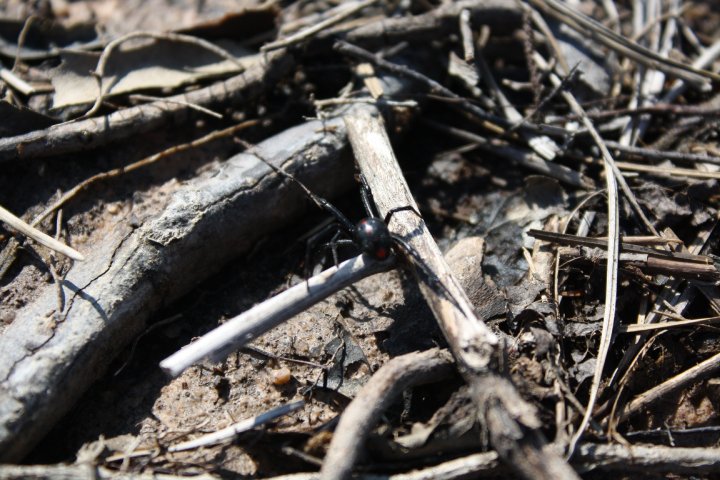
So, the Black Widow Spider, most people recognize the female by the classic red hour class located on the abdomen. You may be surprised to know that they do not always have that red hour glass. As you can see in the picture below, some may just have small, red blotches.


Black Widow. Photo by ME.


So of course, female black widow spiders are a solid black coloration, and like other spiders, have eight legs and are arachnids. As far as the males go, they are quite different from the females. According to Jessie Szalay's article "Black Widows: Facts and Information" in the Livescience website at livescience.com. "The male is about half the size of the female. He is lighter in color with red or pink spots on his back." 

Male Black Widow Spider. Photo from Internet.


Looking at the photo you may be thinking that the male is a big critter. Do not be fooled, males are much smaller than the females, I mean they are little fellas.  


Black Widow Spider. Photo by ME. 


As you may already know, these spiders get their name from the females eating their own mates, thus she is a widow! In fact after the mating occurs, the female usually will eat the dude, but, he has such a short life span anyway, it is not a major tragedy in the grand scheme of things. He would not live much longer after mating if he was not eaten. One thing to note is that other female spiders eat their mates on occasions to; Black Widows are not the only ones that do it. 

When she is not eating her man, the black widow generally eats insects and sometimes, other spiders that gets trapped in her cob webs! Of course she kills her prey with her venom.
A really neat thing about black widows is that they have a way of not getting stuck in their own webs and that is due to their "legs are coated in an oily substance... (Szalay)  

In regards to habitat and where Black Widows like to live, well they are found all over the place, geographical wise.  "Black widows are found in temperate regions throughout the world, including the United States, Southern Europe and Asia, Australia, Africa, and much of South America." (Szalay) 

Black Widows can be found in various habitats that yield some kind of damp and dark hiding places; including people's garages and basements. I have encountered them under logs that I rolled on many occasions, They also seem to like to hide under piles of undisturbed leaves and branches too. Or from what I learned from when I was bitten back in 2005, but I will write more about it shortly.

Now that I have wrote about some of the general information about black widow spiders and before I write about their venom, I would like to say that I am not trying to put fear of these animals into people, They are neat critters and can be enjoyed and observed safely. They help us people out by eating insects and other spiders, which helps keep populations in check.

That being said, black widow spiders, like all spiders, are venomous. They and Brown Recluse Spiders are the two species in the United States that can be harmful to people. They have neurotoxin venom, which attacks the nervous system. A bite can be serious but is rarely fatal, Also, it is important to remember that it is only the female black widow spider that can give a nasty bite. The males are not considered harmful to people, though a bite may still hurt. 


Photo from Internet


Back in the fall of 2005, I was bitten by a black widow spider while playing in a large pile of decomposing leaves. They were damp towards the bottom of the pile, which I suppose made for a nice hiding place for these spiders. The thing about a black widow bite is you usually cannot feel the actual bite ( though I have read that there have been some cases that the person has felt it), I did not feel it when my bite occurred, though the next day after being bit ( I did not realize it at this point) I started feeling cramping around my right leg ( I was bitten on my right ankle) and abdomen. I did not think much of it that this point as I had though I was feeling sore from playing various sports with friends on the day of the bite. Then on Monday,two days after being bitten, I began feeling some pain on my ankle. so I checked it and found a bite mark on my ankle that was swollen and was purple. I immediately suspected It was caused by a black widow, but was not entirely sure. In addition, I was still having cramping in my leg and abdomen. Finally, Tuesday came around and when I woke up and got out of bed that next morning, I immediately felt VERY sick. It basically felt like a stomach virus, and I then knew I had likely been bitten by a black widow. I ended up going to the doctor and he confirmed that I did in fact get bit by a black widow spider, but he gave me some medication ( I guess it what some sort of antivenom, but I do not remember what he exactly gave me). It took me over a week to fully recover, but recover I did. Therefore, a bite from these ladies can be serious, but if you seek medical help, it is very unlikely to be fatal. 

Again, my hope and goal is not to scare you, but give you a better understanding of these creatures. Sure, they can give a nasty bite, but they have a place in our ecosystem too, helping to keep insect and other spider populations in check. 


Again, feel free to ask me any questions you may have :)


Sunday, September 21, 2014

My South America Adventure Part 2: Interesting Towns, Cities, and Sights.

Hello Everyone.

Here is my final piece on my Ecuador adventure. Again, I post this to encourage you readers to go out and have an adventure. You do not even have to leave the country to have an adventure. There so many neat places to go and things to do right here in America!

Anyway, here we go...

One day, I had an opportunity to travel with my friends to the capital of Ecuador, Quito. Above is a picture of Quito as we were driving in.  We spent half a day there walking around a neat museum; including where the equator is and the latitude and longitude is 0.

Quito


Picture below, is me at the museum and where you can straddle the equator.  The museum is pretty cool! I did not take many pictures but some of the things we saw included an authentic shrunken head, some guinea pigs and we learned about how they are an important food source. Sort of like a lobster dinner is to Americans.

At the Equator.


A neat thing about the museum was that we had a guide and that there were different activities going on. I do not remember what activity I was doing pictured on the bottom right.


The big activity there at the museum is trying to balance an egg on an nail. I did not succeed in this but a friend in the group did :)  So we spent rest of our time at a mall as well as a few other shops. So, it was a fun day in Quito.

More of Quito


The next neat place I got to travel to was Pacto. This is where I saw the huge beetles I wrote about in my last blog. Here we got to hangout with some locals and hiked to a beautiful waterfall and spent a few hours swimming.

Cool Tree seen along trail to the waterfalls.

Waterfalls.


Swimming Area


This was a pretty awesome place to swim and explore at. I did see some fish too! A really cool thing I got to see there was some ancient writings left behind by the natives. I know the Incas were in the Ecuador Andes at one point, but I do not know if the writings are from them or not. I do believe these writings are at least 1600 years old!

Ancient Writing

So, as you can see, the Andes in Ecuador is an interesting place with lots of cool things to see and do,  Another place I got to see and explore was Otavalo. It was a neat place. We rode in a van there and spent a full weekend there. It was about a 3 hour drive. The scenery on the way was cool and I even got to see a few volcanoes!

Volcano


Otavalo is a unique place in that it is excellent place to shop. There a lot of places that sell leather- made items. Other places that make items from wood. Plus, locals bring out their own handmade goods to sell. It is neat,


Pictured below is not a live animal; it was carved out of wood by one of locals, who was kind enough to allow my group to get some photos.


Here are some pictures of just some areas of Otavalo, I did not get any photos of the marketplace sadly.

Statue in Otavalo


Out front of a restaurant 


So, those are sort of the highlight places I got to see and explore. Ecuador is a really neat country to explore, the Andes in particular.  Again, if you have any questions, feel free to ask.